Frequently asked questions about eyelid surgery
Is upper eyelid surgery the right treatment for hooded eyelids?
A hooded eyelid can be caused by excess eyelid skin pressing down on the upper eyelid. In the worst case, this can impair the field of vision. Another cause is drooping eyebrows. If the elasticity in this area decreases, the skin can also press towards the upper eyelid and intensify the impression of a hooded eyelid.
In other cases, there is ptosis: the edge of the eyelid hangs lower, for example because the muscle that lifts the eyelid is weakened or stretched. Depending on the cause, a different surgical or non-surgical treatment is appropriate. At the Swiss Derma Clinic, we assess not only the excess skin but also the position of the eyebrows and the edge of the upper eyelid. On this basis, we decide together whether an eyelid lift, a brow lift or another procedure is the more suitable treatment.
Can the upper and lower eyelids be tightened at the same time?
A combination of upper and lower eyelid surgery can correct excess skin on the upper eyelids, in the area of the eye bags or on the lower eyelids – in a single operation. The healing phase may then take a little longer. We will be happy to explain the details as well as the advantages and disadvantages of the combined procedure during your consultation at our practice in Zurich.
Can upper eyelid surgery also improve the field of vision?
If there is a lot of excess skin and the eyelids are markedly hooded, upper eyelid surgery brings functional improvements. The field of vision is clear again and no longer impaired by drooping skin. A feeling of heaviness or pressure, which bothers some patients, can also be relieved by an eyelid lift in most cases once the healing phase is over.
Do I need to stop taking medication before eyelid surgery?
You should not stop taking regular medication on your own initiative. In general, blood thinners, certain anti-inflammatory drugs and some preparations and dietary supplements can influence the tendency to bleed. Please therefore tell us about all the medication, vitamins and dietary supplements you take during your consultation.
Can eyelid surgery be performed on dry or sensitive eyes?
Dry eyes do not rule out eyelid surgery. They are common, especially during the menopause or in people who tend to have dry skin in general. However, eyelid surgery (blepharoplasty) can temporarily increase dryness, a foreign body sensation or watery eyes.
Will I be awake during eyelid surgery?
At the Swiss Derma Clinic, eyelid correction is usually performed on an outpatient basis under local anaesthesia. You are awake during the procedure, while the surgical area itself is numbed. Local anaesthesia allows us to perform the procedure without a general anaesthetic. Depending on the findings and the planned scope of the operation, other forms of anaesthesia can be discussed in individual cases.
For many of our patients, the idea of an operation on the eye is unfamiliar. Before the procedure, we explain exactly what will be done and which impressions or sensations you can expect.
Is eyelid surgery painful?
Thanks to the local anaesthesia, there is no pain. After the operation, the eyelids may feel slightly tight and remain sensitive for a while. Swelling and bruising after the operation are temporary side effects.
Where are the scars after eyelid surgery?
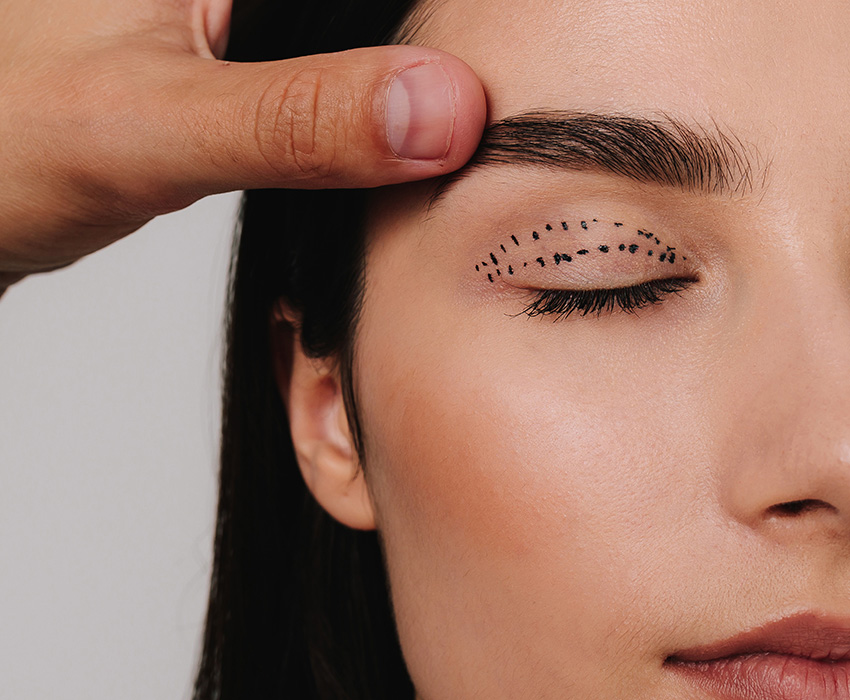
In upper eyelid surgery, we hide the scar in the natural eyelid crease, so that it is barely visible later on. On the lower eyelid, the incision depends on the findings. An incision can run just below the lash line; for certain findings, access from the inside of the lower eyelid is also possible. In the first few weeks after the procedure, the scars are more noticeable and then gradually fade. How inconspicuous a scar ultimately becomes also depends on individual healing.
When are the stitches removed after eyelid surgery?
Non-absorbable stitches are removed within the first one to two weeks. The exact timing depends on the surgical technique. Until then, the operated area should be cared for according to medical instructions and subjected to as little mechanical strain as possible. You should not remove crusts yourself. We will give you precise instructions on wound care.
How long do swelling and bruising remain visible?
Swelling and bruising usually subside considerably within a few days. At first, the eyelids may be noticeably swollen. Minor residual swelling may remain visible for a few weeks.
When can I return to work after eyelid surgery?
Usually after 5 to 10 days if you work in an office or do not do heavy physical work. Swelling or bruising may still be present during this time. If you do physical work, lift a lot or have to bend down frequently, you should allow more time. After combined upper and lower eyelid surgery, the recovery time may be somewhat longer.
When can I do sport again after eyelid surgery?
If possible, avoid sport for about one week. Possible risks include increased swelling or secondary bleeding. Depending on your individual healing process, longer breaks may also be advisable.
When can I drive again?
We advise against driving for at least 24 hours after the procedure. Even after that, only drive yourself once you can see clearly and open your eyes without restriction. Swelling or eye ointments can additionally impair your vision in the first few days.
When can I wear contact lenses again?
Contact lenses could irritate the freshly operated eyelids. A break of about two weeks is recommended. Until then, you can wear glasses if necessary. If your eyes are very dry, it may make sense to wait a little longer.
When can I wear eye make-up again after eyelid surgery?
Wait until the wounds have closed securely and the first healing phase is complete before using eye make-up. If healing is uncomplicated, make-up is usually possible again after about two weeks. Make sure that no excessive tension is placed on the still sensitive scars.
How should I sleep after eyelid surgery?
For the first few days, sleep with your upper body slightly raised and, if possible, on your back. This can reduce swelling and avoids unnecessary pressure on the operated eyelids. As soon as the worst of the swelling has subsided, you can return to your usual sleeping position.
Does lower eyelid surgery get rid of dark circles?
That depends on the cause. Dark pigmentation, visible blood vessels or very thin skin are not removed by the operation. Shadows caused by protruding tissue, on the other hand, are. We therefore examine the cause of your dark circles before treatment.
Does eyelid surgery change the shape of my eyes?
The shape of the eyes is not affected. Our aim is to correct excess skin or bothersome fatty tissue without unintentionally changing the shape of the eyes.
How long does the result of eyelid surgery last?
The result generally lasts for several years. Removed skin does not grow back. However, the natural ageing process continues: over the years, skin and tissue lose elasticity again. How quickly this happens varies from person to person.
Can eyelid surgery be repeated later?
In principle, a further eyelid correction is possible, provided that the eyelid function is stable and there is enough of your own tissue. The first tightening should therefore not be pushed to the limit.
What are the risks of eyelid surgery?
Swelling, bruising, a feeling of tightness or temporarily dry and irritated eyes are among the more common side effects. Less frequently, secondary bleeding, infections, asymmetries or conspicuous scars may also occur. In rare cases, the position of the eyelid margin may change, particularly after lower eyelid surgery. Before the procedure at the Swiss Derma Clinic in Zurich, we provide you with comprehensive information about all possible risks.
Which symptoms should I report immediately?
Severe or suddenly increasing pain, a significant deterioration in vision or rapidly increasing swelling on one side must be examined by a doctor immediately. The same applies to pronounced redness or unusual discharge from the eye.
Who performs eyelid surgery at the Swiss Derma Clinic?
Eyelid surgery is performed by Dr. med. (I) Nunzioluca Chianese, Specialist FMH for Plastic Surgery. He has more than eleven years of experience in eyelid surgery. During the personal consultation, he examines the upper and lower eyelids, the individual position of the eyebrows, eyelid function and the entire anatomy of the eye area.