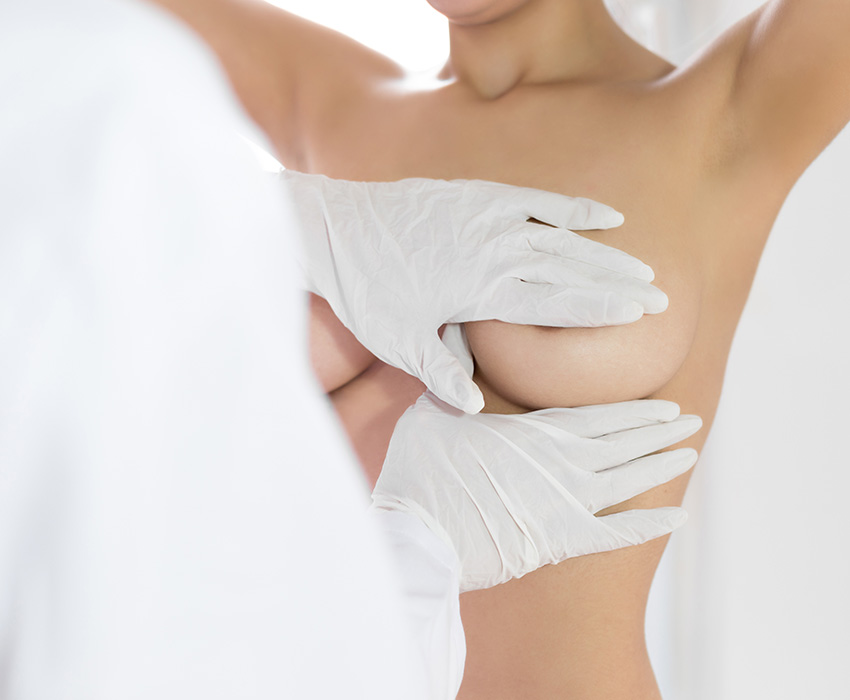
Is breast surgery synonymous with augmentation? Many people think so, but this is a misconception. The majority of women who come to us at the Swiss Derma Clinic with a desire for change do not want larger breasts. What they want is firming and support. In short: a younger version of their own breasts. It is about an aesthetic silhouette and a harmonious shape. Sometimes we need more volume or an implant to achieve this. For example, if there is too little of your own tissue. In other cases, tightening alone is sufficient. And in still others, a combination. What suits when and for whom is very individual.
First we clarify the initial situation
A breast correction consultation at the Swiss Derma Clinic takes around 45 minutes. We need this time to clarify all the important points for you.
- How much intrinsic volume is available?
- How elastic is the skin?
- Where is the nipple in relation to the underbust crease?
If the nipple sits below the underbust fold, we speak of a ptosis – the breast has sagged. In this case, the primary concern is repositioning and shape.
Option 1: Breast augmentation with implants
We recommend implants, for example, if:
- little of the patient’s own tissue is available and the breast naturally has little volume,
- a visible volume build-up is desired,
- more projection is the goal, i.e. a chest that is facing forward, not just upwards.
Modern implants differ in shape, projection and size. Which one fits depends on your body statics and skin elasticity. Standard recommendations or „desired sizes“ are not useful.
Good to know: If the implant is too large and the skin is weak, it will sink again in the long term. If it is too small, the result will appear flat. This needs to be weighed up. We discuss this in the initial consultation, based on a clinical examination.
The procedure takes about one to two hours under general anesthesia. The final result is only visible after several months, when the implant and tissue have settled.
Option 2: Breast augmentation with autologous fat
In lipofilling, the body’s own fatty tissue, usually from the abdomen, hips or thighs, is removed, processed and injected into the breast. No foreign material, no artificial implant.
What is possible with autologous fat:
- moderate volume increase, usually half a cup size to a maximum of one cup size per session,
- Equalization of asymmetries,
- very natural transitions,
- Improvement of tissue quality due to the stem cells contained.
Which is not feasible:
- achieve greater volume leaps,
- tighten sagging skin.
Some of the injected fat is broken down again by the body. Depending on the blood circulation and individual healing process, around 60 to 80 percent is permanently retained.
Autologous fat can suit patients who want a subtle change and have sufficient fat reserves.
Option 3: Breast lift without implants or autologous fat
If there is sufficient volume but the breast has sagged, a mastopexy (breast lift) is the method of choice. An implant would not solve the problem. During a breast lift:
- excess skin removed,
- the breast tissue is remodeled,
- the nipple is brought into an anatomically correct position.
The size hardly changes, but the contour and projection do. The breast has more support and appears more youthful.
Scars are unavoidable with this procedure. Their appearance depends primarily on the individual scar predisposition. Procedures such as PRP or laser can improve the scar structure over time. We offer both at the Swiss Derma Clinic in Zurich.
Combinations often make sense
A single method does not always solve the problem completely. Volume loss and sagging skin often occur together, especially after pregnancy or severe weight loss. A simple augmentation is not enough if the skin is not elastic enough. In such cases, a combination can produce more consistent results:
- Lifting and implants if there is a lack of volume and the skin has sagged,
- Lifting and autologous fat if the contour is to be refined and transitions softened,
- Implant and autologous fat to soften hard transitions at the edge of the implant and achieve a more natural overall appearance.
The best option can only be determined on the basis of a clinical examination. You are welcome to make an appointment for this at the Swiss Derma Clinic in Zurich.
Often underestimated: skin quality
Stretch marks, connective tissue weakness and loss of elasticity affect the surgical result and durability. With an augmentation, the tissue must be able to support the volume in the long term. This is why the examination and individual consultation is perhaps the most important step when it comes to breast implants, autologous fat or a breast lift.
Advice is the most important step
During the consultation, we will look together at what you want, what is anatomically possible and where the limits lie. We discuss alternatives, risks and also what we would advise against.
FAQ
Does breast surgery affect the ability to breastfeed?
This depends on the technique chosen. With modern procedures, glandular tissue and milk ducts are spared as much as possible. In the case of pronounced tightening or complex procedures, the ability to breastfeed at a later date cannot be guaranteed. If you want to have children, you should definitely discuss this in advance.
Can implants be removed or replaced later?
Implants can be removed or replaced in the event of capsular fibrosis, hardening of the connective tissue around the implant, changes in position or a change in aesthetic preference. Every follow-up operation is a surgical procedure with a corresponding healing phase.
Does the result change with weight fluctuations?
Autologous tissue and transplanted fat react to weight changes, implants do not. If you opt for autologous fat, you should know that transplanted fat tissue also loses volume when you lose weight. Significant fluctuations put a strain on the skin and can lead to sagging of the breast in the long term. The weight should therefore remain within a stable range as far as possible.