In short: Nail fungus can show up as whitish, yellowish or brownish discolouration, thickened nails and crumbling nail edges. However, appearance alone cannot reliably tell you whether a fungus is really the cause. You can keep your feet dry, care for your nails gently and use your own personal care tools. Which treatment is right depends on whether a fungus is confirmed, how far the changes extend and your general health.
1. Check your nails and skin
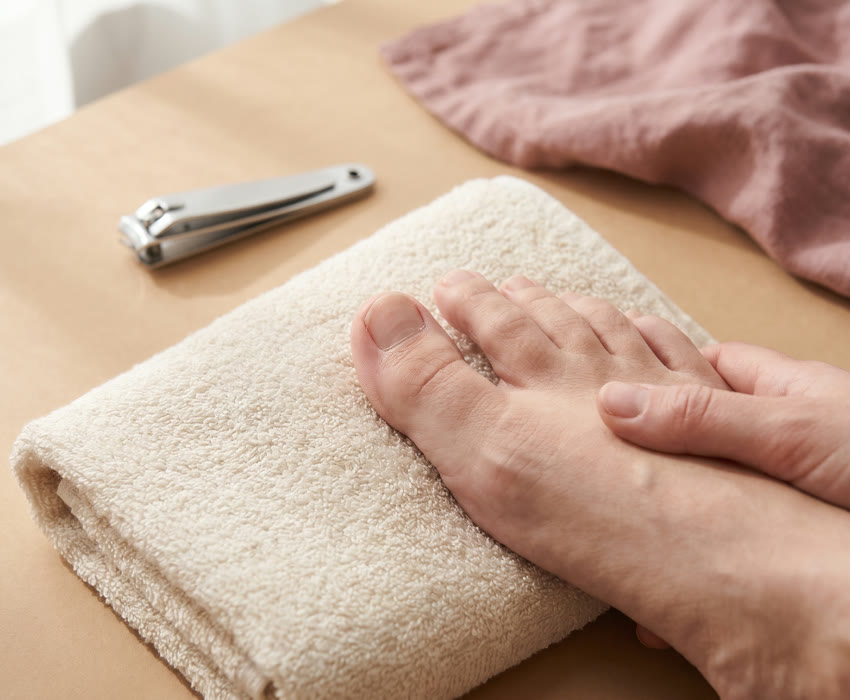
The medical term for nail fungus is onychomycosis. It can affect both fingernails and toenails. On the feet, the change often begins at the front or side edge of the nail and may gradually spread.
Look at your nails in good light. This checklist helps you describe changes for a consultation:
- Colour: Have whitish, yellowish or brownish areas appeared?
- Thickness: Has a nail become thicker or harder to cut?
- Surface and edge: Does the nail feel rough, does it split or does the tip crumble?
- Attachment to the nail bed: Is part of the nail lifting, or is crumbly material collecting underneath?
- Surrounding skin: Is the skin between your toes itchy or flaky? Are there cracks?
These skin signs may point to accompanying athlete’s foot. Such an infection can spread to the nails and should be treated at the same time. Nail fungus is possible without any pain. Conversely, none of these signs proves a fungal infection on its own.
2. Consider other causes
A discoloured nail is not automatically a fungal nail. Pressure from shoes, an injury or psoriasis can cause similar changes. Small pits in the nails, for example, can occur with nail psoriasis. Cosmetic nail polish can also change the colour of the nail.
| Observation | May fit with | What helps to assess it |
|---|---|---|
| Yellowish, thickened toenails with a crumbling edge | Nail fungus, but also pressure from shoes | Laboratory examination of nail material |
| Itchy, flaky skin between the toes | Accompanying athlete’s foot | Having skin and nails assessed together |
| Small pits in several nails | Nail psoriasis | Having the skin and scalp assessed as well |
| Discolouration after a knock or new shoes | Injury or pressure damage | Watching whether the area grows out |
| Yellowish nails after frequent nail polish | Discolouration from polish | A break from polish, then reassess |
Before your appointment, think about when you first noticed the change: was there an injury, new tight shoes or a known skin condition? Which nails are affected? Have you already applied a product? This information helps with the assessment. A photo can document the course, but it does not replace a fungal test.
The checklist is not a diagnosis
Reliable confirmation requires examining affected nail material. A new or changing dark stripe running along the nail should be assessed by a dermatologist. Do not treat it yourself as nail fungus.
3. What you can do yourself
Careful foot care can support treatment and reduce possible routes of transmission. Hygiene alone, however, does not reliably clear an existing nail fungus. Go through the following points in your daily routine:
- Dry your feet well: After washing, carefully dry the spaces between your toes too. Do not leave the skin damp for longer than necessary.
- Change socks and shoes: Put on fresh socks every day, and more often if you sweat a lot. Let shoes dry completely and choose well-fitting, breathable styles.
- Wash textiles properly: Wash socks and towels at 60 °C if the fabric allows it.
- Use your own tools: Do not share nail scissors, clippers, files, shoes or towels. Clean nail tools after use and disinfect them with a suitable product according to the instructions.
- Trim nails carefully: Cut toenails straight across and not deep at the sides. Do not dig or scrape under the nail with sharp objects, and do not tear off loose pieces of nail.
- Protect yourself in shared areas: Wear flip-flops in swimming pools, changing rooms and communal showers. If nail fungus is confirmed, suitable disinfection of your footwear can also help prevent reinfection.
If your nails are too thick to cut safely or you find it hard to reach your feet, get support. Our medical foot care in Zurich also covers nail problems. Professional trimming and thinning of thickened nail can complement antifungal treatment. It does not replace finding out the cause.
4. Find the right treatment
For a confirmed, limited infection, an antifungal medicated nail lacquer may be an option. Among other things, it matters how much of the nail is affected and whether the nail root is involved. Ask for advice on choosing and using a product rather than applying any lacquer to every nail change.
Check before you start: Is the product specifically intended for nail fungus? How should the nail be prepared? How often do you need to apply it, and how are lacquer residues removed? Instructions differ from product to product. Follow the package leaflet and the agreed treatment plan. An ordinary cream for athlete’s foot is not automatically suitable for treating the nail.
With more extensive infection, several affected nails or involvement of the nail root, treatment with tablets prescribed by a doctor may be needed, often combined with a topical treatment. Before starting, the diagnosis, possible interactions and existing conditions must be checked. Depending on the medication, blood tests are part of this.
Expect treatment to take months. The damaged nail has to grow out, even when the infection is already receding. A clear new section growing at the base of the nail can be a good sign, but it does not prove that the infection is completely gone. So do not stop treatment on your own as soon as the nail looks better.
For home remedies such as tea tree oil, there is not enough reliable evidence to replace established nail fungus treatment. Ordinary cosmetic nail polish does not treat the fungus either. Discuss any additional products before combining them with your treatment.
5. When is medical advice important?
Have an unclear nail change checked, especially if it is getting worse, affecting other nails or bothering you when walking. If a correctly used treatment does not help, the diagnosis should also be reviewed. Simply trying one product after another can mean that a different cause is missed.
Seek medical advice early if you have diabetes, circulation problems, reduced sensation in your feet or a weakened immune system. In that case, do not work on thickened nails yourself with sharp tools. For children, and during pregnancy and breastfeeding, it should be clarified before treatment which products are suitable.
If the skin on your toe is painful, hot and swollen, or if redness is spreading, have it checked promptly. This may indicate an additional skin infection. Such inflammation should not be treated with nail lacquer alone.
6. How we assess a suspected infection
At Swiss Derma Clinic in Zurich, we offer assessment and treatment of nail fungus. On our treatment page we describe microscopic examination and detection of fungal genetic material. This allows a suspicion to be checked more precisely than by looking at the nail alone.
Let us know which medications you take and whether you have already used antifungal products. Prior treatment can affect the test. Ask before your appointment how to prepare for a nail sample. Do not stop a prescribed treatment without consulting us.
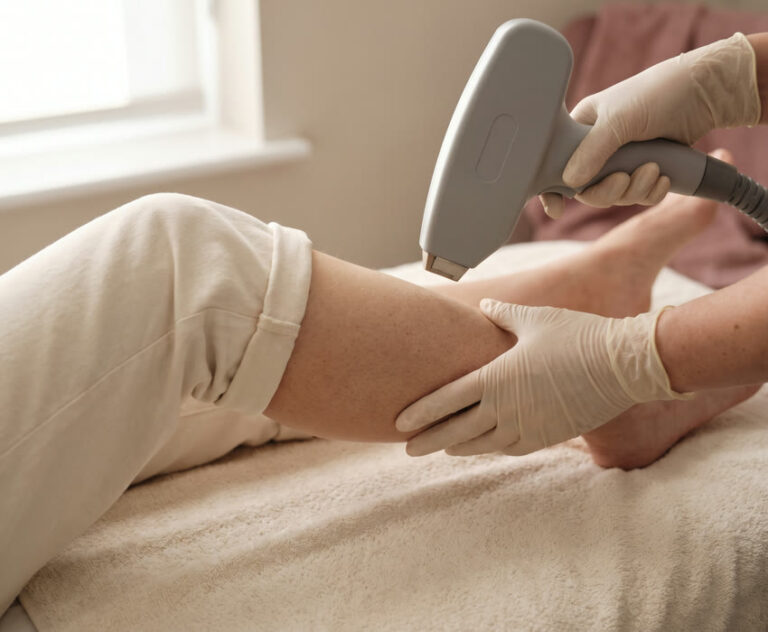
Our services also include laser treatment, which we usually combine with a topical treatment such as a medicated nail lacquer. Whether it makes sense for you is something we discuss once the findings are available. As a stand-alone treatment, laser has been studied less thoroughly than lacquer and tablets, and no method can promise a particular result. You can find more information on our page about nail fungus treatment in Zurich.
Frequently asked questions
Is nail fungus contagious?
The fungi can be passed on via shared items and contaminated surfaces. That is why using your own nail tools, towels and shoes makes sense. Not every contact leads to an infection. Moisture and already damaged nails can make it more likely.
Does nail fungus go away on its own?
You should not count on it. An existing infection usually persists. Whether and how it is treated also depends on your symptoms and personal risks. Not every mild change calls for tablets straight away, but it does call for a reliable assessment first.
Does an affected nail have to be removed?
Not as a rule. Depending on the findings, it may be enough to professionally remove thickened or loose parts and treat the infection in a targeted way. Removing the nail is only considered in selected situations. Never remove the nail yourself.
Why does the nail still look changed?
A treated nail does not become smooth and clear straight away. Changed areas grow out slowly. Sometimes nail damage remains visible even after the infection has cleared. That is why appearance and a fungal test are different criteria when judging success.
Can nail fungus come back after treatment?
Yes. A relapse or reinfection is possible. Treat any accompanying athlete’s foot, keep your feet dry and keep using your own personal care tools. If new changes appear, another assessment makes sense.
This article does not replace a medical examination.