Who is allowed to perform filler treatments in Switzerland?
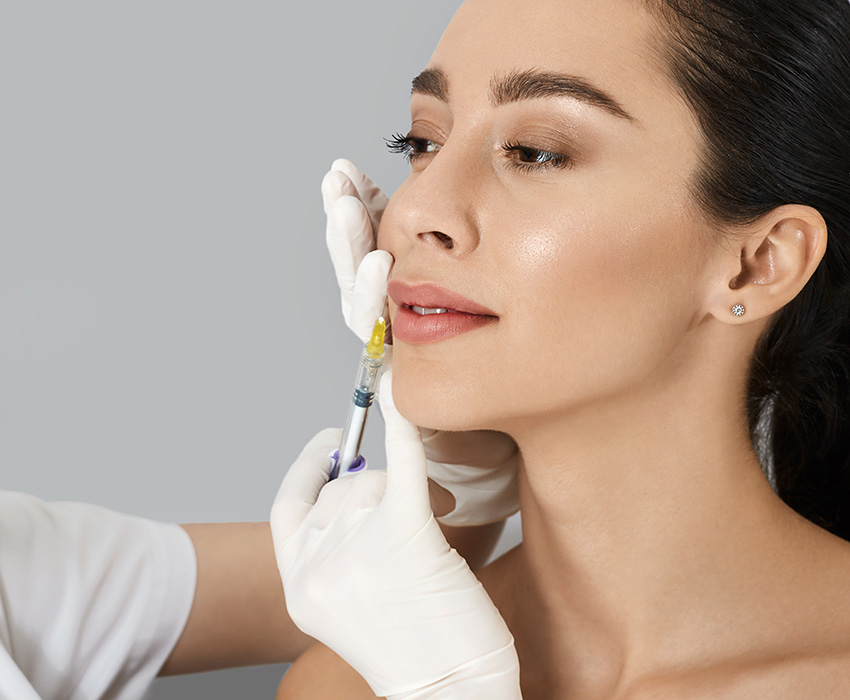
Most fillers contain hyaluronic acid, in a more fluid or firmer consistency depending on the desired effect. They are injected into the tissue at different depths. With fillers, we can contour areas of the face such as the jawline, perform a liquid facelift or fill wrinkles such as the nasolabial fold. Achieving the effect you want requires in-depth medical knowledge – and a medical qualification.
In Switzerland, these treatments are reserved for doctors: besides a safe injection technique, they require precise anatomical knowledge and the ability to recognise and treat possible complications at an early stage. Beauticians and non-medical practitioners do not have the corresponding qualifications.
Recognising complications safely and quickly
One of the rare but serious risks of a filler treatment is vascular occlusion. If the filler enters a blood vessel, it can impair the blood flow there.
Warning signs can include pain or a net-like discoloration of the skin. Particularly high demands on anatomical knowledge and injection technique apply in regions rich in blood vessels, such as the upper cheek area, around the mouth or in the nasolabial area.
Serious complications, up to and including visual disturbances, are very rare. What matters is recognising and treating complications reliably and promptly.
The effect of hyaluronidase on hyaluronic acid fillers
Hyaluronic acid fillers can be broken down again with the enzyme hyaluronidase. This requires sensitivity and very careful dosing, for example in the case of unwanted filler accumulations or for corrections.
Besides medical qualifications, the right product is essential
Filler products must meet medical requirements, be stored correctly and must not be used after their expiry date.
Not all fillers are the same – each composition behaves differently in the skin. Patients should ask which product is being used and who manufactures it.
The right amount of filler?
The amount required depends on the product itself, its composition and consistency, the facial proportions, the extent of the treatment, the skin structure and the desired result. For treatments covering larger areas, such as filling sunken cheeks, a larger amount of hyaluronic acid is usually required than for filling individual wrinkles.
For lip corrections, we use a different filler than for the cheeks or the jawline.
How to recognise qualified filler treatments
Before a treatment, ask:
- Who performs the injection?
- What medical qualifications does this person have?
- Which product is used?
- What is the procedure in the event of complications?
- Is a follow-up appointment possible at short notice?
Hyaluronic acid fillers at the Swiss Derma Clinic Zurich
At the Swiss Derma Clinic, we select fillers to suit the facial region and the desired change.
All of our specialists have the necessary experience. Evangelia Georgouli, specialist and medical director of the Swiss Derma Clinic in Zurich, has been recognised as an expert by the Global Health Academy and by the hyaluronic acid manufacturers Allergan and Galderma, and is a member of the advisory board of the medical company Merz. At the Swiss Derma Clinic, we run further training courses and hyaluronic acid workshops for doctors.